Snow Loads: What's Changed in the New Code?
By Jack Healy, P.E., Principal
Significant updates to snow load requirements are now in effect in New York. The State Fire Prevention and Building Code Council has updated the Uniform Fire Prevention and Building Code, and anyone designing or reroofing buildings began to feel the impacts starting December 31, 2025, when the 2025 Building Code of New York State (BCNYS) was officially adopted. The main headline: the way we figure out snow loads—for both new and existing buildings—got an overhaul.
The 2025 BCNYS now points to the ASCE/SEI 7-22 standard, which utilizes more recent snow data and recent research than the old ASCE/SEI 7-16 version. This includes new statistics, new drift design approaches, and—maybe most noteworthy—new rules about how insulation changes snow buildup on heated roofs. For reroofing projects, these changes will affect your design.
How the New Snow Load Calculations Work
Everything starts with ground snow load maps. The new maps have grabbed 40 extra years of weather and snowfall data compared to previous versions, and now they sort buildings by risk categories instead of just how often heavy snow hits. There are now four different snow maps depending on the risk type, and they are now based on “strength or ultimate loads,” which already factor in a safety multiplier. This is the first time that snow loads are presented as ‘strength’ level versus ‘service’ level loads for New York State. The Figure below shows the Risk Category III map from ASCE 7-22.

Why does this matter? Strength-level loads used for strength-based design or LRFD (Load and Resistance Factor Design) represent the maximum or worst case load your building could see in its lifetime, and these are compared with ultimate capacities. Service or allowable level loads represent typical load levels, and these are compared with allowable capacities. Strength design is a more consistent way to design. This change aligns the snow load approach with both wind loads and seismic loads, which have been presented as strength level loads for some time. If you still want to see the old service-level roof loads, you just multiply the new roof strength level roof snow load by 0.7.
Bonus: the “importance factor” is gone and is now accounted for in the four snow maps for each risk level.
When comparing apples to apples, the actual roof loads may go up in some areas, down in others, it all depends on where you are.
What’s New with Drift?
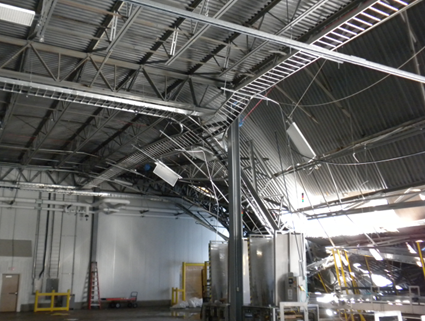
Drifts are the main culprit behind snow load failures. The Photograph below shows a collapsed bay of roof framing due to excessive loading from drift.
Even though the code does not always demand drift analysis for simple reroofing projects, many engineers (our team included) always consider drift loads because older buildings are especially vulnerable since drifted snow loads were not addressed in early versions of the code.
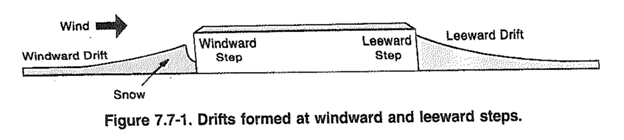
Drifts pile up anywhere the roof changes height, like steps, parapets, or big projections. The rules for snow drifts started with the 1979 state code. The figure below from ASCE 7-22 shows the snow profile at a vertical projection.
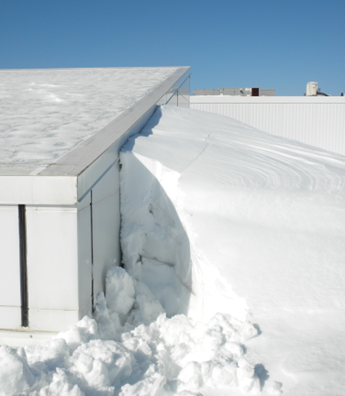
The Photograph below shows an actual drift profile.
The latest version, ASCE 7-22, adds a “winter wind parameter” (called W₂) to measure just how windy your average winter is—which matters for how much snow piles up in drift-prone zones. New research also tweaks the shape and spreads of windward drifts, so the load isn’t always bigger, but it does spread across more of your roof. That could mean extra stress on some parts of the roof depending upon where the roof framing spans are supported.
More Insulation = More Snow?
Back during the energy crisis, codes started requiring more roof insulation to prevent heat loss through the roof to save energy. But there’s a catch: better insulation means snow melts off slower, leaving more snow on the roof when the next storm rolls through. If you are redoing a roof, it’s smart (and often required) to double-check the structure to make sure it can handle the newer, heavier snow load.
Until now, the code was vague about how insulation affected snow loads—basically, if your building was heated, you got a flat adjustment factor no matter how thick the insulation was. That didn’t make much sense. A thin layer leaks heat and melts snow, while a super-thick layer does not leak heat and the snow just keeps piling up. The new code finally ties snow load adjustment to your actual insulation value, using a sliding scale based on R-value (the measure of insulation strength) and ground snow load. As part of the roof snow calculations for unvented roofs, you need to look at the new Thermal Factor, and if you are using tapered insulation, use the average R-value.
Below is a quick comparison of 2020 snow loads versus 2025 snow loads for three cities, showing how the new rules stack up. These are service level numbers, in pounds per square foot, with the new rules assuming R33 insulation and a roof exposure factor of 1.0 (most common category):
|
Location |
Risk Category |
ASCE 7-16 |
ASCE 7-22 |
psf change |
|
Albany |
2 |
28 |
34 |
6.00 |
|
3 |
31 |
38 |
7.00 |
|
|
4 |
34 |
42 |
8.00 |
|
|
Syracuse |
2 |
35 |
44 |
9.00 |
|
3 |
39 |
49 |
10.00 |
|
|
4 |
42 |
56 |
14.00 |
|
|
Buffalo |
2 |
35 |
33 |
-2.00 |
|
3 |
39 |
37 |
-2.00 |
|
|
4 |
42 |
41 |
-1.00 |
The Biggest Changes Are for Existing Roofs
Here’s where it becomes important: these new snow load rules might force changes on older buildings, not just new ones. Reroofing projects fall under the “Alteration Level 1” work category. If the total load (dead load plus snow load) goes up by 5 percent or more (compared to the original design, not just what is there now), you will need to meet all the new standards. Depending on the existing dead load of the roof, the new maps along with a small increase in R-value could be the tipping point for the 5-percent trigger. Existing roofs that are relatively lightly framed are more susceptible to exceeding the 5-percent trigger when considering all the reroofing factors.
What If My Old Roof Isn’t Strong Enough?
There are several strategies to address these code changes.
First, review the dead loads of the roof carefully. Often, dead loads are rounded up during design to be conservative, and those rounding assumptions can accumulate into a few pounds per square foot. Also, many of the older roof systems were heavier than new roof systems so there may be a few pounds per square foot to pick up there.
Second, consider material testing of the existing structure. Sampling and laboratory testing will usually provide higher material properties for the existing structure than assumed values.
Third, reinforce the structure to support the updated code requirements. There are several strategies for reinforcing roofs depending upon the structural systems and other design parameters.
Lastly, if reinforcing the structure is not an option, and your old framing just can’t handle the new, heavier snow load, the Department of State addressed this during the commentary period:
“For structural modifications required as a result of decreased snow melt (which could potentially result in increased snow load) due to increased insulation requirements of the Energy Code, Sections C503.1 and R503.1 of the 2025 ECCCNYS state “Alterations shall not create an unsafe or hazardous condition or overload existing building systems.” This allows a designer/owner to use resources such as an engineering analysis to show the limitations of the capacity of the existing structure to safely support additional loads resulting from increased insulation requirements. In cases where the increased insulation would overload the capacity of the existing structural elements, the Energy Code permits engineering analysis to be used to limit the amount of required insulation to an amount which does not create an unsafe or hazardous condition or overload an existing building system.”
Summary
These changes to snow load rules bring in new data, up-to-date research, and more accurate snow load calculations, especially when it comes to effects of insulation. Existing buildings will get the biggest shakeup, with many older roofs likely to need reinforcing. And if bringing your insulation up to code risks overloading the structure, engineers have ways to work with the code to keep things safe. Bottom line: if you are planning a roof project in New York, now is a great time to have an engineer take a hard look at your snow loads and make sure your plans are up to date.
This article includes contributions from Lauren Marci (Structural Design Intern). Special thanks to Professor Emeritus Michael O’Rourke from Rensselaer Polytechnic Institute, for his insights during our phone conversation, as well as for his NCSEA webinar presentation, “Snow Loads in ASCE 7-22: What’s New and Different.”